A mutual fund in Pakistan pools money from many investors, and an asset management company (AMC) invests it in shares, government securities, bank deposits or a mix. You buy units at the fund's net asset value (NAV), and the unit price moves with the value of what the fund owns. Funds are regulated by the Securities and Exchange Commission of Pakistan (SECP), and the Mutual Funds Association of Pakistan (MUFAP) publishes their NAVs and returns. On 5 November 2026 MUFAP's report listed 404 open-end funds and plans. This guide covers the types, what each returned over the past year, the fees, the tax and a method for choosing one.
Key points
- The fund type decides where your return comes from and how far the NAV can fall. Choose the type first, then the fund.
- Over the 365 days to 5 November 2026, the median money market fund returned 10.5% and the median equity fund 3.0%. Over three years the order flips: equity funds' median was +194% in total.
- Equity fund returns ranged from −16.6% to +26.0% in the same year, so picking the fund still matters.
- SECP caps management fees by fund type, from 0.75% a year for index funds and ETFs to 3% for equity funds.
- Mutual fund units are not bank deposits. You can lose money, and deposit protection does not cover them.
What is a mutual fund and how does it work in Pakistan?
A mutual fund, legally a collective investment scheme, is a pool of money managed by an SECP-licensed AMC, with the assets held by a separate trustee. You own units in the pool, and the value of each unit is the fund's NAV. MUFAP publishes NAVs and returns for every fund.
Open-end funds let you buy and redeem units directly with the AMC at the NAV on any working day. Most retail investors use these. Exchange-traded funds (ETFs) hold a similar pool, but you buy and sell them on the PSX through a broker, like a share.
MUFAP's 5 November 2026 report sorts its funds into five groups:
| Group | Count | What it is |
|---|---|---|
| Open-end funds | 404 | Bought from and redeemed with the AMC, the usual route |
| Voluntary pension schemes (VPS) | 88 | Retirement sub-funds |
| Employer pension funds | 55 | Retirement funds run for employers |
| Exchange-traded funds | 8 | Traded on the PSX |
| Dedicated equity funds | 6 | Equity funds set up for particular investors |
What are the types of mutual funds in Pakistan?
The main types are money market, income, equity, asset allocation, balanced and index funds, most with a Shariah-compliant (Islamic) version. The type decides where the return comes from and how far the NAV can fall.
| Type | Invests in | Return comes from | Risk (relative) | Median 365-day return | Lowest to highest |
|---|---|---|---|---|---|
| Money market | Short-term government paper, bank deposits | Interest | Low | 10.48% | 9.47% to 11.26% |
| Income | Longer government and corporate debt | Interest, price changes | Low to medium | 10.23% | 4.20% to 17.31% |
| Balanced | Shares and debt in a set range | Both | Medium | 7.47% | −1.69% to 19.46% |
| Asset allocation | Shares, debt and cash, mix varies | Both | Medium to high | 4.58% | −21.88% to 19.11% |
| Equity | Listed shares | Dividends, price rise | High | 3.03% | −16.61% to 26.02% |
| Islamic money market | Shariah-compliant short-term paper | Profit | Low | 10.54% | 1.10% to 11.18% |
| Islamic income | Sukuk, Islamic bank deposits | Profit, price changes | Low to medium | 9.41% | 5.73% to 10.71% |
| Islamic asset allocation | Screened shares, sukuk and cash | Both | Medium to high | 6.15% | −3.96% to 16.08% |
| Islamic equity | Shares screened by a Shariah adviser | Dividends, price rise | High | 3.27% | −10.94% to 20.95% |
Source: MUFAP performance report, 5 November 2026, open-end funds with a one-year record. Medians are our calculation. MUFAP reports money market and income returns as annualised figures. Past returns do not predict future ones.
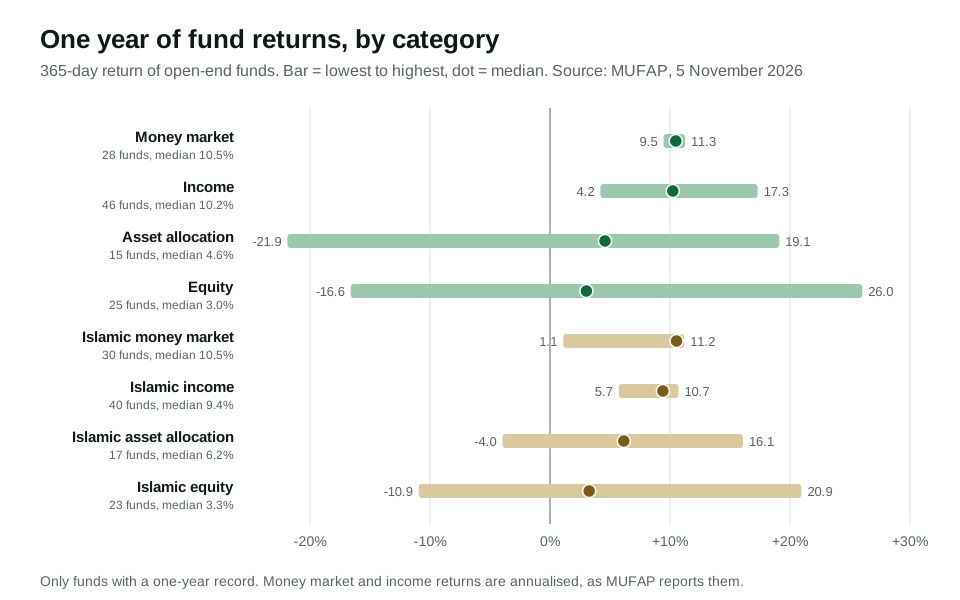
Two more types are smaller. Index trackers follow a market index for a low fee, and MUFAP lists one conventional and one Islamic open-end tracker. Fund-of-funds products invest in other funds. For how a fund compares with holding shares yourself, read mutual funds vs direct stocks.
Why one year of returns is a poor guide
A single year can rank these types in the wrong order for a long-term investor. The same MUFAP report, for funds old enough to have each record:
| Period to 5 Nov 2026 | Median money market fund | Median equity fund | Median Islamic equity fund |
|---|---|---|---|
| 1 year | 10.5% | 3.0% | 3.3% |
| 2 years | 11.4% a year | +71.4% in total | +62.0% in total |
| 3 years | 16.4% a year | +194.2% in total | +168.7% in total |
Money market figures are annualised and equity figures are totals, so compare them with care. Older funds only appear if they survived, and those years included a strong PSX rally that may not repeat. Even so, the pattern is clear: in the latest year, 15 of the 48 equity funds with a one-year record lost money, yet every equity fund with a three-year record was up by more than 100%.
How much do mutual funds cost?
Funds charge a management fee and other expenses inside the NAV, and may charge a sales load when you buy or a back-end load when you sell. The total expense ratio (TER) shows all the yearly running costs as a share of the fund's assets.
SECP replaced its old TER caps with caps on the management fee in 2025. These apply per year on average daily net assets, from 1 July 2025:
| Fund type | Management fee cap |
|---|---|
| Equity | Up to 3.00% |
| Income, aggressive income, commodities | Up to 1.50% |
| Money market | Up to 1.25% |
| Fixed rate or return | Up to 1.00% |
| ETFs and index funds | Up to 0.75% |
These are ceilings on one charge, as reported from SECP's notification, and we found no later change as of 5 November 2026. Your fund's actual costs are in its monthly fund manager report and offering document.
| Cost | What it is | Where to see it |
|---|---|---|
| Management fee | Yearly fee to the AMC, deducted from NAV | Fund manager report |
| Total expense ratio | All yearly costs as a share of average assets | Fund manager report |
| Front-end load | Fee when buying units, often waived online or direct | Offering document |
| Back-end load | Fee on early redemption, in some funds | Offering document |
A small difference compounds. In this illustration with made-up returns, Rs 100,000 growing at 9% a year after costs becomes about Rs 236,700 in 10 years. At 8% after costs, because the fund costs 1% more, it becomes about Rs 215,900. That 1% cost about Rs 20,800.
How are mutual fund returns taxed in Pakistan?
The fund deducts tax for you, and the rate depends on the type of income and whether you are on FBR's Active Taxpayer List (ATL). These are the rates for individuals in tax year 2027 (1 July 2026 to 30 June 2027):
| Income | On the ATL | Not on the ATL |
|---|---|---|
| Dividend, part earned from equities | 15% | 30% |
| Dividend, part earned from debt securities | 25% | 50% |
| Gain when you redeem units | 15% | Higher, ask your AMC |
Sources: PwC tax summary (reviewed 24 August 2026) and BACO Consultants on the Finance Act 2026 (2 November 2026). Rates change with each budget, so check them with your AMC or a tax adviser. A money market fund's dividends fall mostly in the 25% line and an equity fund's mostly in the 15% line. Choosing to reinvest a dividend does not avoid the tax.
Zakat can also apply. Fund documents state that units held by resident Pakistanis are subject to Zakat at 2.5% of their value, deducted from redemption proceeds unless you give the AMC a declaration in time. Check your own fund's offering document.
For shares, see our separate guide to tax on shares.
Mutual fund or direct shares: which suits me?
Funds suit people who want diversification and professional management without picking stocks. Direct shares suit people who want control and no yearly management fee, and who can research companies. Many investors use both.
- Choose funds if you start small, invest monthly or do not want to follow companies.
- Choose direct shares if you have time, can use a broker and accept more risk per holding.
See risk, diversification and position size for the logic, and how shares make money if you want to understand what an equity fund owns.
How do I invest in a mutual fund in Pakistan?
Open an account with the AMC, online or at a branch, using your CNIC and bank details, then transfer the money. You receive units at the applicable NAV. Each fund sets its own minimum in its offering document.
- Pick the fund type that matches your goal and time frame.
- Read the fund manager report and offering document on the AMC's site.
- Open an account and complete the AMC's KYC form with your CNIC and bank account details.
- Transfer money to the fund's account and receive units at the applicable NAV.
- Track the NAV on MUFAP, and redeem when you need the money.
Getting your money back. You submit a redemption request to the AMC. Payment normally takes up to six working days, and redemptions can be suspended or delayed in special circumstances. A request made after the fund's cut-off time is processed on the next working day.
Overseas Pakistanis should ask the AMC which account types it accepts money from. Our Roshan Digital Account guide covers the route for buying PSX shares.
If you are new to investing altogether, begin with our get started guide.
How do I choose a mutual fund?
Choose by goal first, then compare cost, track record, size and manager across funds of the same type. A fund's top return in one year is a poor guide.
- Goal and time. Under one year: money market. Three to five years: income or balanced. Over five years: equity, accepting large swings.
- Compare within the category. Compare an equity fund with equity funds, never with a money market fund.
- Look at 3- and 5-year returns against the fund's benchmark, and at the worst fall in NAV.
- Check cost. TER and loads.
- Check the AMC and the fund's rating. MUFAP shows a rating where a fund has one, such as AA+(f) on ABL Cash Fund.
- Shariah status. If it matters, check the Shariah adviser's certificate. See Shariah-compliant investing.
Worked example: Rs 100,000 needed in two years
This uses the 5 November 2026 figures, but it is a scenario and not a forecast. Returns will differ.
- Money market fund. If the current 10.5% median held for two years, Rs 100,000 would become about Rs 122,100 before tax. After tax that is about Rs 118,800 if the gain is taxed at 15% on redemption, or about Rs 116,600 if it comes as debt-derived dividends taxed at 25%.
- Equity fund. No return can be assumed. In the latest year alone, the weakest equity fund would have turned Rs 100,000 into about Rs 83,400, and the strongest into about Rs 126,000.
For money you need in two years, the possible loss in an equity fund matters more than its possible gain. With a ten-year horizon, the same comparison can point the other way.
Can I lose money in a mutual fund?
Yes. In the 365 days to 5 November 2026, the weakest equity fund lost 16.6% and the weakest asset allocation fund lost 21.9% (MUFAP). Money market and income funds are steadier, but their NAV can still fall in a bad month.
Mutual funds are not bank deposits. The Deposit Protection Corporation protects up to Rs 1,000,000 per depositor at each member bank. Fund units are investments held through an AMC, not deposits at a bank, so do not count on that cover. A bank selling you a fund does not make it a deposit.
Data and method
- Fund returns and counts: MUFAP's NAV Returns Performance Summary, report date 5 November 2026, read directly from the page. We calculated the medians across open-end funds in each category, leaving out funds with no figure for that period.
- Fee caps: SECP's amendment to the NBFC and Notified Entities Regulations, as reported by Business Recorder in 2025. SECP's own press release was not reachable when we checked.
- Tax: PwC and BACO Consultants, linked above. We did not read FBR's own rate card for this guide, so treat these as secondary sources.
- Redemption, Zakat and cut-offs: offering documents and notices from UBL Funds, MCB Funds (Alhamra) and NBP Funds. Rules can differ by fund.
FAQ
What are the types of mutual funds in Pakistan?
The main types are money market, income, equity, balanced, asset allocation and index funds, most with Islamic versions, plus voluntary pension schemes. They differ in what they hold, how they earn and how far the NAV can fall. MUFAP listed 404 open-end funds and plans on 5 November 2026.
Which mutual fund is best in Pakistan?
No fund is best for everyone. The right one depends on your goal, time frame and risk. Compare funds only within the same category, using cost, long-term record against the benchmark and the manager. One year's top fund is a poor guide: equity returns ranged from −16.6% to +26.0% in the same year.
How much money do I need to invest in a mutual fund?
Each fund sets its own minimum in its offering document, and many start at a few thousand rupees or allow small monthly plans. Check the AMC's website or app for the current minimum for your first and later investments. A smaller amount can also spread further in a fund than in individual shares.
Are mutual funds halal in Pakistan?
Conventional funds are not Shariah-compliant. Islamic funds invest only in screened assets and work under a Shariah adviser, and they are listed separately on MUFAP. Check the fund's page and its Shariah adviser's certificate for its status, and ask a scholar you trust about your own case.
How do I redeem my units?
Submit a redemption request to the AMC. Units are sold at the applicable NAV, and the money normally reaches your bank account within six working days. A request after the cut-off time moves to the next working day. Check for any back-end load, tax and Zakat first.
This is education, not investment advice. Past returns do not guarantee future results; read the offering document before you invest.